
These maps present regions currently experiencing long-term (12 month) anomalies using observed temperature and precipitation data from October 2024 through September 2025 (top) and regions likely to encounter significant water anomalies during the one-year period beginning in July 2025 and running through June 2026 using 3 months of observed data and 9 months of forecast data (bottom).
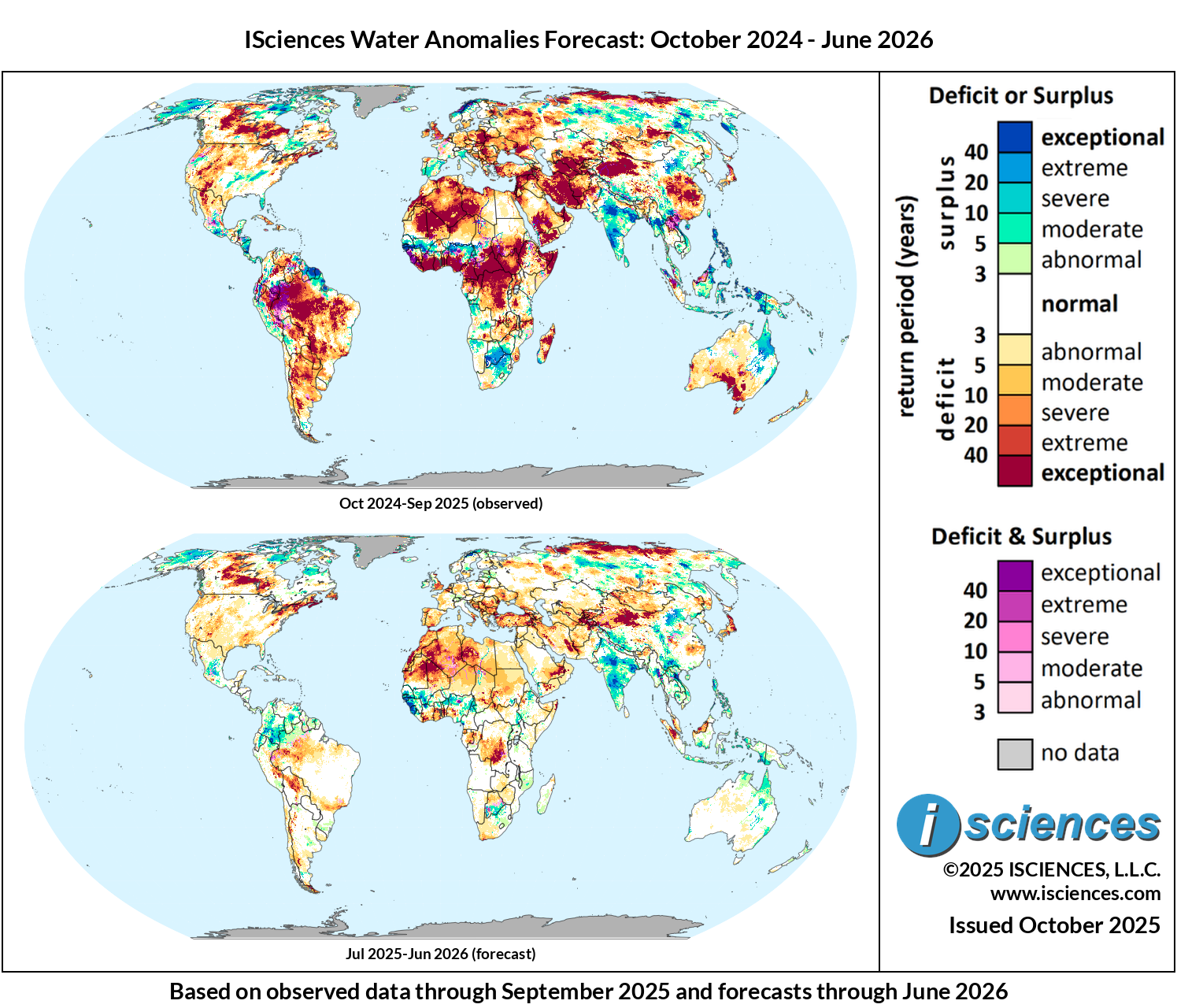
The synopsis that follows provides highlights of regional water forecasts. Regional details are available in ISciences Global Water Monitor & Forecast Watch List October 10, 2025 (pdf).
United States: The forecast indicates extreme to exceptional long-term deficits for much of the northeast United States, including New York, Vermont, New Hampshire, Maine, western Pennsylvania, and West Virginia. Widespread moderate to severe long-term water deficits are forecast across much of the western United States, including Washington, Oregon, Arizona, Utah, Colorado, Arizona, and New Mexico. Similar deficits are forecast for the Lower Mississippi River Basin, including Arkansas, Louisiana, and Mississippi. Severe to exceptional seasonal deficits are forecast for most of the eastern United States during October-December 2025.
Canada: The forecast shows a band of exceptional long-term deficits across the Prairie Provinces including Alberta, Saskatchewan, Manitoba, and Ontario. Moderate surplus conditions are forecast for portions of northern Quebec and the Northwest Territories.
Mexico, Central America, and the Caribbean: Moderate to extreme long-term surpluses are forecast for central Mexico. Exceptional seasonal deficits are forecast for Jalisco and Colima during January-March 2026. Moderate seasonal surpluses are forecast for Panama during January-March 2026.
South America: The forecast indicates moderate to exceptional long-term deficits across central and southern Brazil, Bolivia, and portions of Argentina. Exceptional to extreme long-term surpluses are forecast to persist across northern South America including Ecuador, northern Peru, Colombia, and Venezuela.
Europe: Moderate to exceptional long-term deficits are forecast across most of southeastern Europe, including the Balkans, Greece, Romania, Bulgaria, Moldova and central Ukraine. Moderate to severe long-term deficits are expected in the United Kingdom, Belgium, the Netherlands, Portugal, Spain, and eastern Poland. Moderate seasonal surpluses are expected for Norway, Sweden, Finland, Latvia, Lithuania, Estonia, and western Russia during January-March 2026.
Africa: The forecast shows severe to exceptional long-term deficits persisting across northwestern Africa, including Mauritania, Mali, Morocco, Algeria, and Libya. Moderate to severe deficits are expected across the West African coast including Cote D’Ivoire, Ghana, Togo, Benin, and portions of Nigeria. Extreme to exceptional long-term surpluses are forecast. Extreme long-term deficits are forecast for central portions of the Democratic Republic of the Congo. Exceptional long-term surpluses are forecast for the Gambia, Guinea-Bissau, southwestern Mali, and Guinea.
Middle East: Exceptional long-term deficits are forecast for northern and eastern portions of Turkey, northern Iraq, portions of Iran, southeastern Saudi Arabia, and central Yemen. Exceptional seasonal deficits are forecast for Oman during October-December 2025.
Central Asia and Russia: Exceptional long-term deficits are forecast for the Central Siberian Plateau in Russia. Severe to exceptional long-term surpluses are forecast for portions of Krasnoyarsk Krai.
South Asia: Exceptional to extreme long-term surpluses are forecast to persist across much of India, particularly in central, southern, and eastern regions. Extreme long-term deficits are forecast for western Pakistan.
Southeast Asia and the Pacific: Exceptional long-term surpluses are forecast for northern Viet Nam and Laos, central Myanmar, northern Philippines, and South Papua. Exceptional long-term deficits are forecast for Riau in Indonesia, and Malaysia.
East Asia: Exceptional long-term deficits are forecast for northwest China, western Mongolia, and Japan. Severe to exceptional long-term surpluses are forecast for the Yellow River Basin and southern China. Exceptional seasonal surpluses are expected in Chongqing and Hubei during October-December 2025.
Australia & New Zealand: Moderate to severe long-term surpluses are forecast for Queensland and New South Wales. These will mostly dissipate on a seasonal basis by January 2026.