
These maps present regions currently experiencing long-term (12 month) anomalies using observed temperature and precipitation data from January 2025 through December 2025 (top) and regions likely to encounter significant water anomalies during the one-year period beginning in October 2025 and running through September 2026 using 3 months of observed data and 9 months of forecast data (bottom).
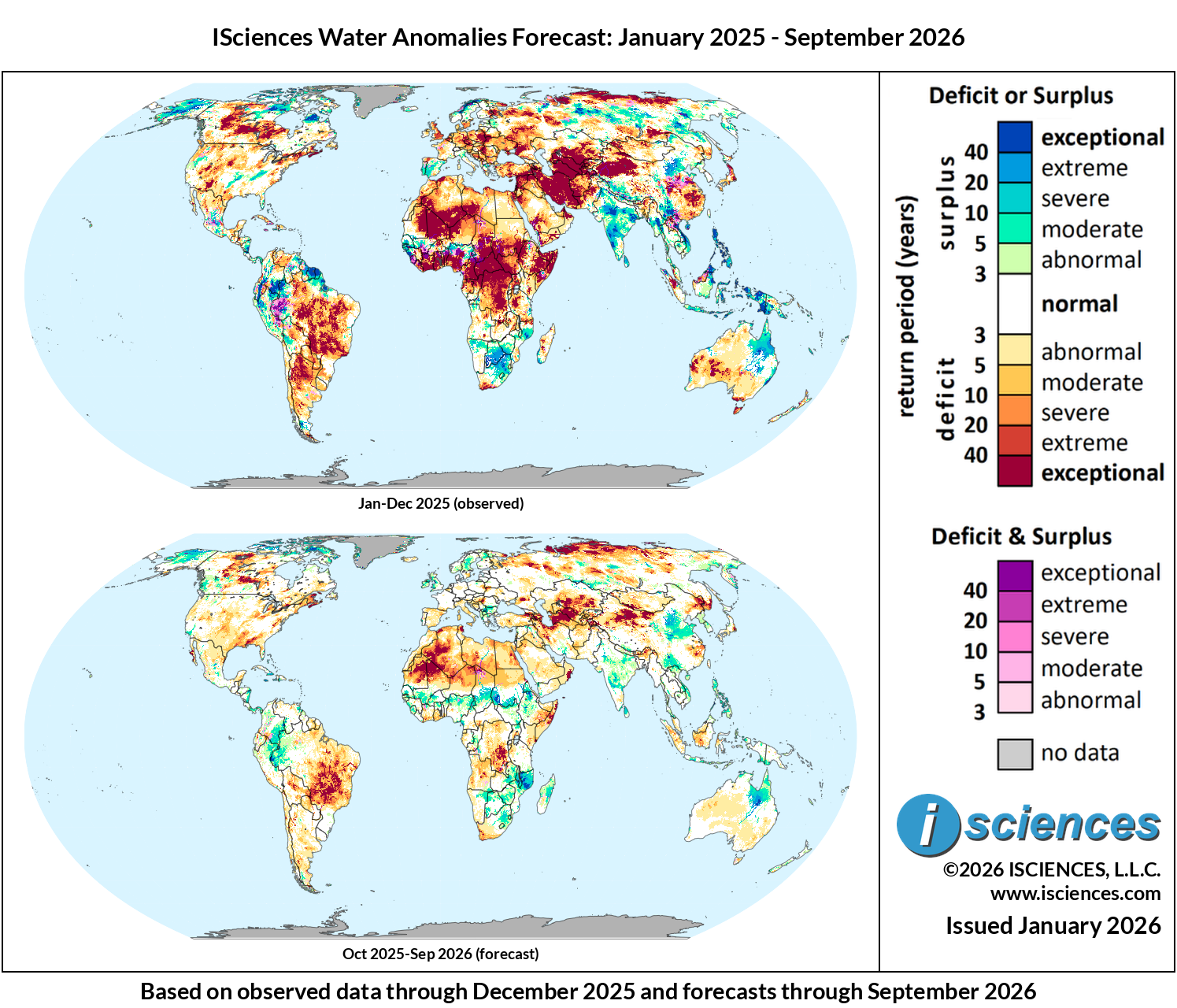
The synopsis that follows provides highlights of regional water forecasts. Regional details are available in ISciences Global Water Monitor & Forecast Watch List January 19, 2026 (pdf).
United States: Observed conditions (Jan-Dec 2025) show exceptional deficits across New England, particularly Maine, New Hampshire, Vermont, and Massachusetts. Severe to exceptional deficits extend across Texas, specifically central and eastern regions near Houston and Dallas. Additional pockets of severe to extreme deficits were observed along the New Mexico-Arizona and the Wyoming-Nebraska-Colorado borders, and in Utah southwest of Salt Lake City. In contrast, exceptional surpluses persist across northern Alaska, while moderate surpluses were observed along the Pacific Northwest coast and the Ohio River heading into the Mississippi River. The 12-month forecast (Oct 2025-Sep 2026) indicates significant improvement across most of New England, but moderate deficits are expected to continue. Relief is also forecast for the southern plains regions. Severe to exceptional deficits may emerge throughout the deep south in eastern Texas, Louisiana, Mississippi, and Alabama and in the midwest along northern Illinois, Indiana, and western Michigan. These deficit conditions are expected to peak in by March 2026 and then return to largely normal conditions for the remaining forecast through September 2026.
Canada: Observed conditions (Jan-Dec 2025) show exceptional deficits across the Prairie Provinces, with the most intense conditions in central Alberta north of Edmonton, extending through Saskatchewan, and into Manitoba and the Ontario border. Northeastern British Columbia moving into the Northwest Territories displayed severe deficits, while coastal regions remain near-normal. The Atlantic provinces including Nova Scotia, New Brunswick, and Prince Edward Island show severe to exceptional deficits, mirroring conditions in neighboring New England. In contrast, northern Quebec and coastal Labrador display moderate to severe surpluses, with additional surplus conditions scattered across the northern territories. The 12-month forecast (Oct 2025-Sep 2026) indicates significant improvement across most of Canada. Exceptional prairie deficits are expected to reduce in their extent, but central Saskatchewan is expected to remain under extreme deficits. Atlantic provinces are expected to find relief from deficits by June 2026. Northern surpluses will continue at reduced intensity, with abnormal to moderate conditions expected across most of the country by summer 2026.
Mexico, Central America, and the Caribbean: Observed conditions (Jan-Dec 2025) show moderate deficits, with pockets of extreme, across nearly all northern Mexico including Baja California, Sonora, and Chihuahua. Central Mexico near Guadalajara displays mixed deficit and surplus conditions, while the Yucatan Peninsula shows moderate deficits. In the Caribbean, western Cuba experienced severe to exceptional deficits, while Haiti and the Dominican Republic displayed exceptional surpluses in coastal regions. Eastern Cuba and Jamaica experienced mixed conditions. Central America presents contrasting patterns with moderate to severe surpluses in Nicaragua, Costa Rica, and Panama, while Guatemala and Honduras show moderate deficits. The 12-month forecast (Oct 2025-Sep 2026) indicates substantial improvement across most of the region. Deficits in Northwest Mexico are expected to moderate except in Baja were exceptional deficits are forecast to emerge. Caribbean deficits will moderate significantly. Scattered moderate surpluses are expected to remain throughout the Guadalara region and in Central America.
South America: Observed conditions (Jan-Dec 2025) show exceptional deficits across the Amazon basin, particularly severe in the Brazilian states of Amazonas and Pará along the Amazon River. Deficits extend into central Brazil including Mato Grosso and Goiás, with severe conditions reaching the São Paulo metropolitan region and spreading into Paraguay along the Paraná River. In contrast, northern South America shows exceptional surpluses across Colombia, Venezuela, and the Orinoco River basin, extending into Guyana, Suriname, and French Guiana. Ecuador and coastal Peru also display moderate to severe surpluses. The 12-month forecast (Oct 2025-Sep 2026) indicates dramatic improvement across the Amazon region, with deficits expected to diminish from exceptional to moderate or near-normal levels, however, southern Brazil and Paraguay are forecast to remain under moderate to extreme deficits. Surpluses throughout eastern Columbia and Peru are expected persist in lesser intensity, while those through eastern Venezuela, Guyana, and Suriname will return to near normal conditions.
Europe: Observed conditions (Jan-Dec 2025) show exceptional deficits across the Balkans including Greece, Bulgaria, North Macedonia, Albania, and Serbia, extending into central Turkey. The United Kingdom experienced severe to exceptional deficits, particularly across eastern England. Exceptional deficits were also observed along the Poland-Belarus-Ukraine border region near the Bug River. In contrast, moderate to severe surpluses dominated the Iberian Peninsula across Spain and Portugal, with additional surpluses along the Norwegian coastline and in northern Italy. The 12-month forecast (Oct 2025-Sep 2026) indicates significant improvement across most of the continent. Balkan deficits are expected to diminish substantially, with some areas transitioning to moderate surpluses. UK conditions will improve, with moderate surpluses potentially emerging in western England and Ireland. The Poland-Belarus-Ukraine border region is forecast to return to near-normal, with the exception of the Bug River basin–where exceptional deficits are expected to persist through summer 2026. Iberian surpluses will transition to abnormal deficits, and most of central and western Europe is expected to remain near-normal.
Africa: Observed conditions (Jan-Dec 2025) show severe to exceptional deficits across North Africa including Morocco, Mauritania, Mali, Algeria, Tunisia, Libya, and along the Nile River in Egypt. The West African coast from Sierra Leone through Liberia, Côte d’Ivoire, Ghana, Nigeria, and Cameroon also experienced severe to exceptional deficits. These exceptional deficits extend into Central Africa in the Central African Republic and throughout much of the Democratic Republic of the Congo (DRC) along the Congo River basin. In stark contrast, exceptional surpluses stretch across the Sahel from Senegal through southern Mali, Burkina Faso, Niger, with scant areas of mixed surplus and deficit conditions in central Chad extending into South Sudan and western Ethiopia. Southern Africa including Botswana, Zimbabwe, and portions of South Africa shows moderate to severe surpluses. The 12-month forecast (Oct 2025-Sep 2026) indicates North African deficits will persist but diminish in intensity to moderate-severe levels. West African coastal deficits are expected to improve to a mix of abnormal and moderate deficits. DRC deficits will persist; particularly in southern regions. Sahel surpluses will moderate but continue. Southern African surpluses are forecast to diminish toward near-normal conditions.
Middle East: Observed conditions (Jan-Dec 2025) show exceptional deficits across nearly the entire eastern half of the region. Southeastern Turkey, Syria, and Iraq experienced exceptional deficits along the Tigris and Euphrates River basins. Iran displays exceptional deficits throughout the entirety of the country. Lebanon, Jordan, and Israel show severe to exceptional deficits. The Arabian Peninsula experienced moderate to severe deficits with exceptional conditions near the Makkah region. Yemen shows exceptional deficits in the interior and southwestern regions. Oman, UAE, and Qatar display moderate to severe deficits. The 12-month forecast (Oct 2025-Sep 2026) indicates significant improvement across most of the region. Iran is expected to improve though exceptional deficits may persist along the Caspian coast. Iraq, Syria, and Turkey will transition to moderate deficit levels. The Arabian Peninsula is forecast to improve overall, with moderate surpluses potentially emerging in southwestern Saudi Arabia and Yemen by mid-2026, however, widespread exceptional deficits are forecast in Oman south of Muscat.
Central Asia and Russia: Observed conditions (Jan-Dec 2025) show exceptional deficits across Central Asia including Kazakhstan, Uzbekistan, Turkmenistan, Tajikistan, and Kyrgyzstan. Particularly intense conditions were observed around the Aral Sea basin and along the Amu Darya and Syr Darya river systems. Western Russia experienced moderate to severe deficits. In contrast, eastern Siberia and Russia’s Far East display moderate to severe surpluses. The 12-month forecast (Oct 2025-Sep 2026) indicates significant improvement across Central Asia, with deficits expected to diminish from abnormal to moderate levels, but wide swaths of exceptional deficits are forecast to persist heading into Uzbekistan across Turkmenistan and towards the Caspian Sea and along the northern coastline. Western Russia will transition toward near-normal conditions. Eastern Siberian surpluses are expected to continue but at reduced intensity with most of the region trending toward more moderate conditions by summer 2026.
South Asia: Observed conditions (Jan-Dec 2025) show widespread surpluses across India, with exceptional conditions in southern states including Karnataka, Tamil Nadu, Kerala, and Andhra Pradesh near Bangalore and Chennai. Moderate to exceptional surpluses extend across central and northern India along the Ganges River basin. Eastern Pakistan along the Indus River valley displays moderate to severe surpluses. Nepal and Bhutan display moderate to severe surpluses. Sri Lanka shows moderate to severe surplus conditions. The 12-month forecast (Oct 2025-Sep 2026) indicates that much of the region will transition toward near-normal conditions. Indian surpluses are expected to diminish significantly, though moderate surpluses may persist in central-southern India through early June 2026, and mixed surplus and deficit conditions are forecast to emerge in the west during January-March 2026. Pakistan, Bangladesh, and Sri Lanka are forecast to return to near-normal conditions by mid-2026.
Southeast Asia and the Pacific: Observed conditions (Jan-Dec 2025) show exceptional surpluses across the Philippines. Mainland Southeast Asia including Thailand, Vietnam, Laos, Cambodia, and Myanmar displays moderate to exceptional surpluses. In stark contrast, Sumatra Indonesia experienced severe to exceptional deficits. The 12-month forecast (Oct 2025-Sep 2026) indicates the region will transition toward near-normal conditions overall. Philippine surpluses are expected to diminish significantly. Mainland Southeast Asia will moderate toward normal conditions with moderate surpluses along the eastern coast. Indonesian deficits are forecast to persist but at reduced intensity, particularly in Sumatra and western Kalimantan.
East Asia: Observed conditions (Jan-Dec 2025) show exceptional deficits across western Mongolia and northwestern China including Xinjiang. Southern China displays mixed conditions with moderate to severe surpluses in southern areas near Guangxi and Yunnan provinces, while moderate to exceptional deficits were observed in southeastern provinces west of Shanghai. South Korea remains mostly near-normal with scattered moderate anomalies. Taiwan displayed moderate surplus conditions in the southeast, and Japan experienced severe to exceptional deficits across much of the country. The 12-month forecast (Oct 2025-Sep 2026) indicates significant improvement across the region. Exceptional deficits across southwest Mongolia and northwestern China are expected to diminish in extent, but will persist through September 2026. Similar reductions in deficit extent and severity are expected west of Shanghai with a return to near normal conditions by June 2026. Japan is forecast to improve substantially, returning to mostly near-normal conditions, however, Tokyo is expected to remain under deficits until April 2026.
Australia & New Zealand: Observed conditions (Jan-Dec 2025) show moderate to severe surpluses across northern Australia including the Northern Territory and northern Queensland, extending south into the Lake Eyre watershed. In contrast, Tasmania and interior South Australia experienced severe to exceptional deficits. Western Australia experienced severe to exceptional deficits surrounding Shark Bay and heading east into the Western Plateau. New Zealand shows moderate to severe deficits across both the North and South Islands, particularly in coastal regions. The 12-month forecast (Oct 2025-Sep 2026) indicates dramatic improvement across the region. Most of Australia is expected to transition toward more normal conditions with abnormal deficits throughout most of the western half and southeast provinces. Northern surpluses will lessen slightly, but extreme (and pockets of severe) surpluses are forecast to persist south into the Lake Eyre basin. New Zealand is expected to return to near-normal conditions by mid-2026.