
These maps present regions currently experiencing long-term (12 month) anomalies using observed temperature and precipitation data from June 2025 through May 2026 (top) and regions likely to encounter significant water anomalies during the one-year period beginning in March 2026 and running through February 2027 using 3 months of observed data and 9 months of forecast data (bottom).
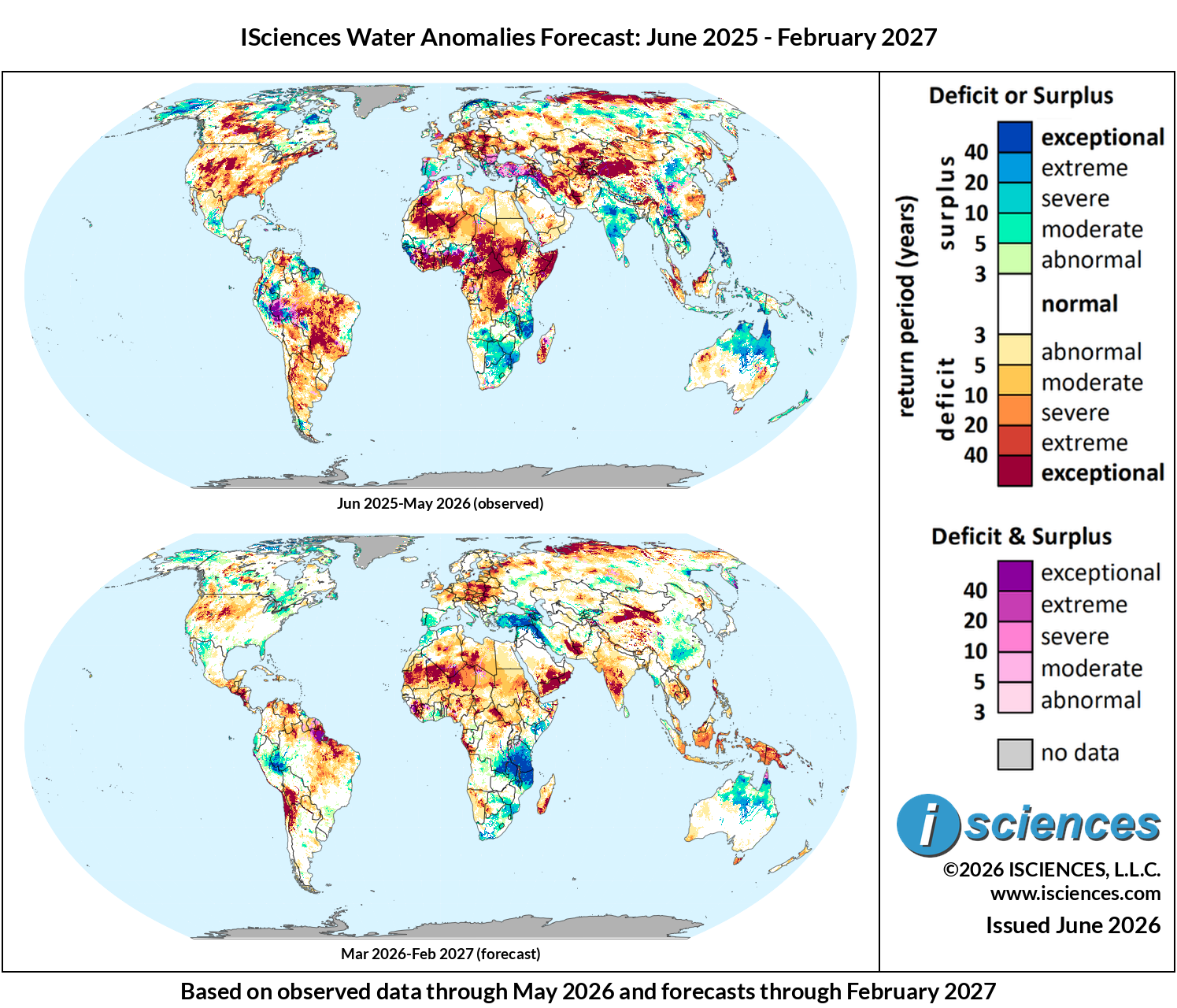
The in focus and regional synopsis sections that follow provide highlights of regional water forecasts. Detailed regional maps are available in the full report: ISciences Global Water Monitor & Forecast Watch List June 15, 2026 (pdf).
In Focus: Probability of El Niño Increases, Drought in the West, Crisis in Africa
Pacific sea surface temperature anomalies continue to track above the 2.5°C threshold. The WMO’s June–August 2026 update now places the probability of El Niño conditions at 80% for the summer season and one the strongest ENSO events on record. This month’s WSIM In Focus highlights two emerging stories–an increasing water emergency in the American West, and divergent impacts across sub-Saharan Africa where ENSO is suppressing the rainy season in the drought-stricken Horn while prolonging flooding in the southeast.
Emergency in Colorado
Governor Polis declared a statewide drought emergency for Colorado in early June 2026 after winter snowpack came in well below normal and spring runoff failed to materialize. Reservoir storage across the Colorado River basin is at multi-decade lows heading into peak summer demand. The Colorado River system supplies water to more than 40 million people and irrigates roughly 5.5 million acres of farmland across seven U.S. states. Conditions in the basin are a direct concern for federal agencies, water managers, and the National Integrated Drought Information System (NIDIS) community. The emergency declaration unlocks emergency water-sharing mechanisms and infrastructure response funding, but the structural deficit in snowpack and storage will not be remedied quickly.
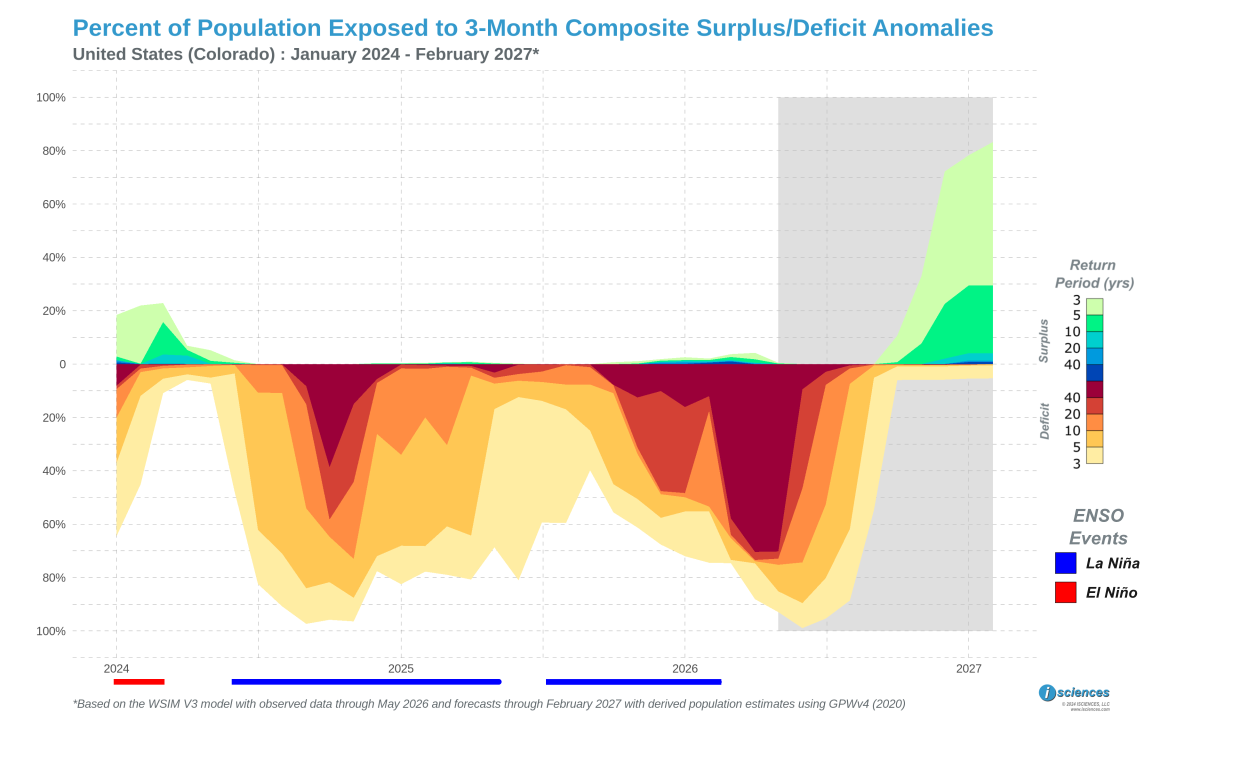
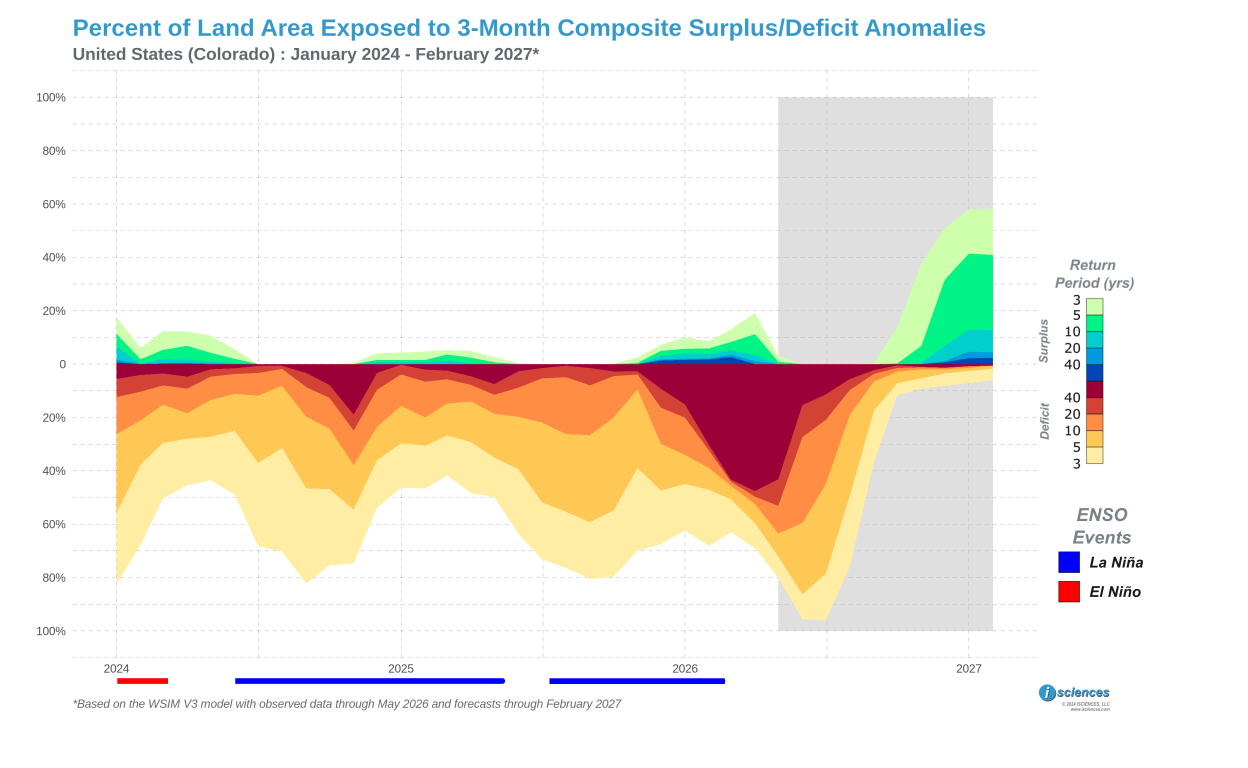
The latest WSIM 3-month population exposure analysis for Colorado through May 2026 shows 80% of the population and 50% of the land area are currently under exceptional drought conditions.
El Niño presents contrasting signals for the West over the next 9 months. Warmer, drier conditions are expected through summer. However, El Niño events historically deliver above-normal precipitation to the Southwest and Colorado basin. Our most recent WSIM regional forecast for the United States (Figure 7 in the full report) predicts Colorado will transition to surpluses beginning in Fall 2026.
Africa: Droughts, Floods, and the Impacts of War
In east Africa, El Niño is reorganizing water security across sub-Saharan Africa — but with drastically different results.
In the Horn of Africa, drought has increased in the absence of long and short rains since 2021, leaving an estimated 42 million people across Ethiopia, Somalia, Kenya, and Sudan facing acute food insecurity. FEWS NET’s December 2025 alert reports that the October–December 2025 Deyr season had “essentially failed” across the eastern Horn, with crop losses reaching 54% in Ethiopia’s East Hararghe Zone and 15–16 million Ethiopians projected to need urgent food assistance by July 2026. The emerging 2026 El Niño may exacerbate the situation. FEWS NET’s May 2026 East Africa Seasonal Monitor notes that early El Niño development has historically been associated with reduced Kiremt (June–September) rainfall across Ethiopia’s kiremt-producing areas. The WSIM seasonal (3-month) anomaly forecasts for Africa (Figure 17 below) anticipate deficit conditions continuing in the Horn through 2026, with widespread exceptional deficits emerging in Somalia during Dec 2026–Feb 2027. However, severe to extreme surpluses are expected to emerge in southern Somalia beginning Oct 2026.
Hydrologic deficits are compounded by the geopolitical disruption to the global fertilizer supply. IFDC’s May 26 briefing documents the farm-level impact of the Strait of Hormuz closure since February 28, 2026: trading prices of nitrogen fertilizers have doubled while other fertilizer blends have risen by 30–80%. Drought and fertilizer deficits are coming at precisely the time Horn farmers need inputs to buffer against the potential Kiremt failure. FAO has named Somalia’s situation a “triple threat” — ongoing drought, conflict-driven supply disruption, and El Niño — noting that fuel prices in Mogadishu have doubled from roughly $0.60 to $1.50 per liter, cascading into food, transport, and input costs. Communities already battling drought must simultaneously prepare for potential El Niño–driven flooding. WSIM’s monthly anomaly forecast for May-January predicts surpluses along the Juba and Shabelle rivers later in 2026. Despite the compounding crises, Somalia’s 2026 Humanitarian Response Plan remains only 11.3% funded.
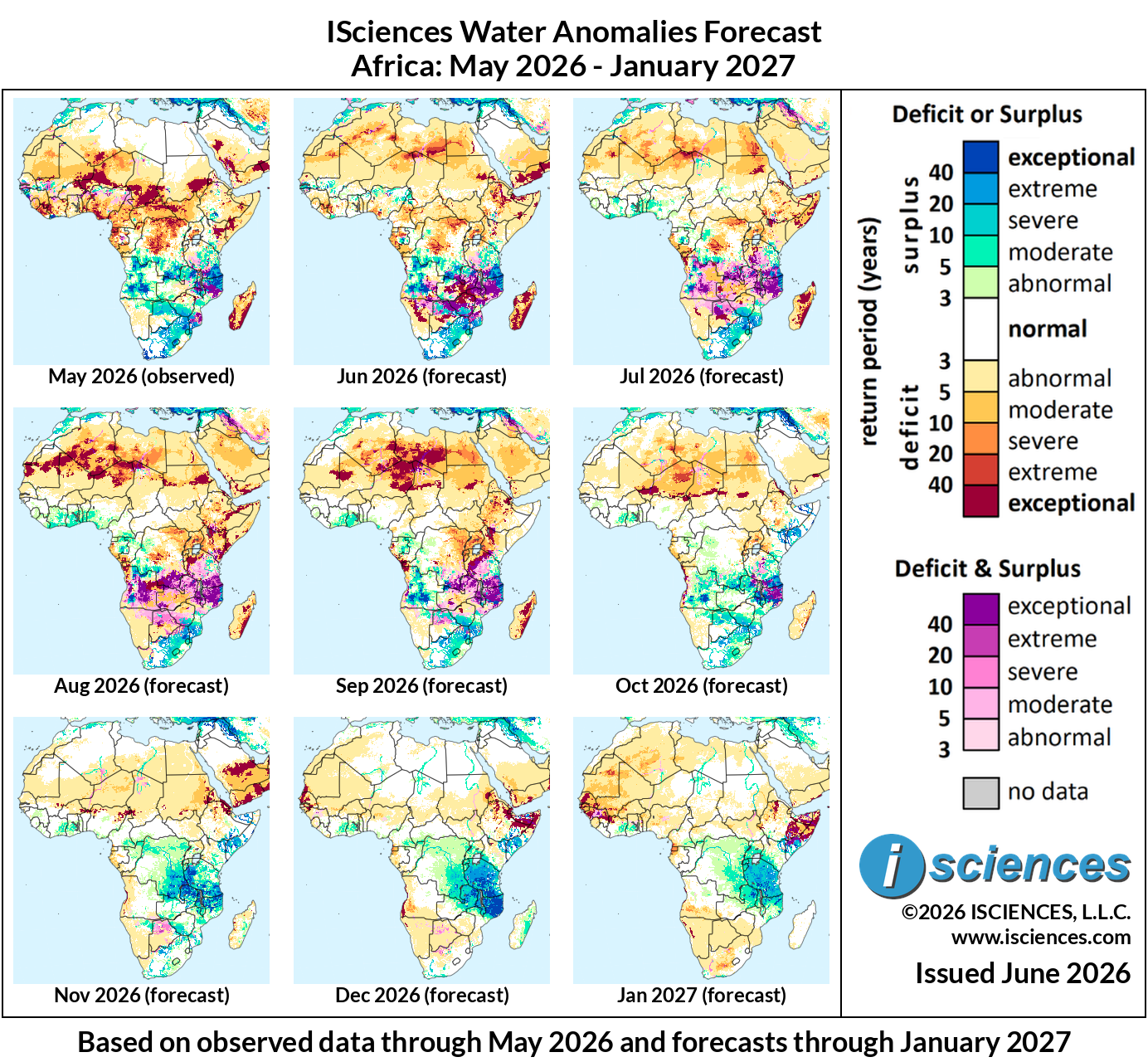
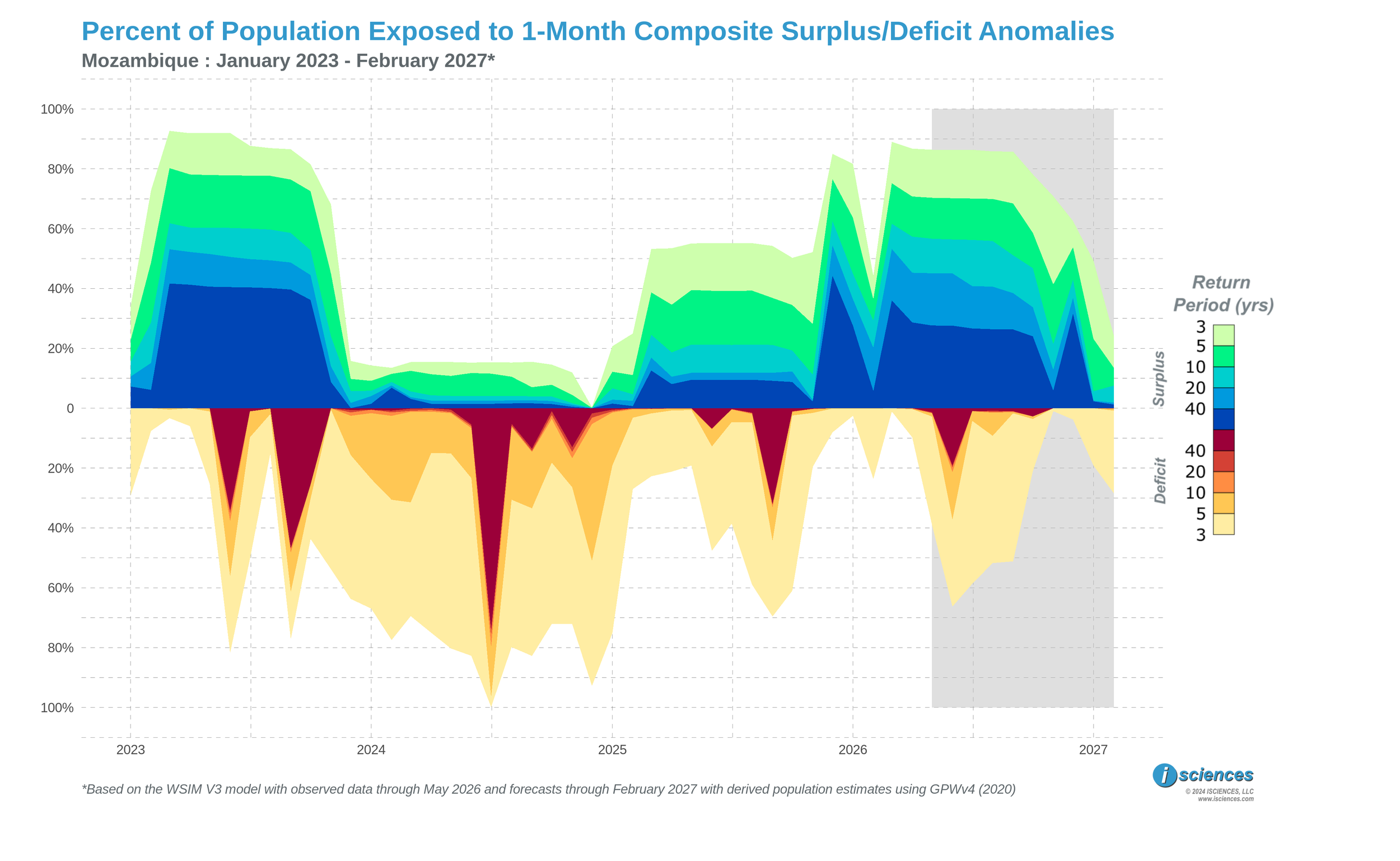
South of the Horn, La Niña driven flooding since mid-December 2025 has affected an estimated 1.5 million people, killed over 300, and displaced more than 170,000 across Mozambique, Tanzania, Malawi, Zambia, Zimbabwe, and South Africa and yet there is no relief in sight. El Niño historically results in complicated patterns across southern Africa, and the Southern African Development Community recently reported that the evolution of this El Niño event is unlike any from the past 40 years. The WMO Global Seasonal Climate Update for JJA 2026 shows an enhanced probability of above-normal rainfall continuing across southern parts of Africa. WSIM’s regional forecast predicts continued surpluses in central-east Africa for the remainder of 2026, and WSIM’s Population Exposure Analysis estimates nearly 85% of Mozambique’s population is currently under a water surplus and for that number to remain until Fall 2026. A rapid attribution study by World Weather Attribution found that extreme rainfall spells across the region have become approximately 40% more intense since pre-industrial times, raising the baseline exposure for each new event.
Sources:
WMO El Niño/La Niña Bulletin — June–August 2026. World Meteorological Organization, June 2026.
Colorado is now in a statewide drought emergency. CPR News, June 4, 2026.
Colorado River Basin. U.S. Bureau of Reclamation.
Somalia faces a triple threat of drought, Middle East conflict, and predicted El Niño flooding. FAO Somalia, 2026.
The Strait of Hormuz and the African Farmer. IFDC, May 26, 2026.
Historic dry rainy season triggers alarm for deepening food insecurity in the Horn. FEWS NET, December 2025.
Ethiopia Food Security Outlook Update — December 2025. FEWS NET, December 2025.
Highly variable seasonal conditions and developing El Niño signals concerns across East Africa. FEWS NET, May 2026.
Public Health Situation Analysis — Flooding across Southeast Africa. World Health Organization, 2026.
Global Seasonal Climate Update — JJA 2026. World Meteorological Organization, 2026.
La Niña, climate change, and vulnerability combined led to devastating floods in parts of Southern Africa. World Weather Attribution, 2026.
Evolution of 2026 El Niño event unlike any from the past 40 years. Southern African Development Community (SADC), 2026.Regional Synopsis
Watch List: Regional Synopsis
United States: Observed long-term conditions (Jun 2025–May 2026) show exceptional deficits across the Colorado River basin, the lower Mississippi Basin, and in the east from North Carolina all the way to Maine. The seasonal (3-month) forecasts anticipate the El Niño signal delivering a rapid transition to above-normal surpluses to nearly the entire region by Sep-Nov 2026. The only exceptions being the Upper Midwest and Pacific Northwest, which are expected to experience scattered pockets of moderate to severe deficits.
Canada: Observed long-term conditions (Jun 2025–May 2026) show a large contiguous block of severe to exceptional deficits across the Prairie provinces extending into western Ontario. The seasonal (3-month) forecasts indicate Prairie deficits reducing in intensity and extent, with most of Canada approaching near-normal by Sep-Nov 2026.
Mexico, Central America, and the Caribbean: Observed long-term conditions (Jun 2025–May 2026) show moderate deficits across northern Mexico alongside mixed to moderate surplus conditions across central Mexico, Nicaragua, and Panama. The seasonal (3-month) forecasts show the potential El Niño transitioning northwest Mexico into surpluses, and southern Mexico and Central America into widespread moderate to exceptional deficits beginning Jun-Aug 2026.
South America: Observed long-term conditions (Jun 2025–May 2026) show exceptional surpluses across Colombia, Venezuela, and the Guiana Highlands while a broad band of severe to exceptional deficits persist across central Brazil (Mato Grosso, Goiás, Minas Gerais) and the upper Paraná basin. The seasonal (3-month) forecasts indicate El Niño amplifying surpluses across northern Argentina and the southernmost portion of Brazil. However, surpluses in the Amazon, Peru, Ecuador, and Colombia will transition to normal to dry conditions in Sep-Nov 2026. Severe to exceptional surpluses are expected to emerge along their western coasts in Dec 2026–Feb 2027.
Europe: Observed long-term conditions (Jun 2025–May 2026) show a persistent band of severe to exceptional deficits across central and eastern Europe stretching from France, south into the Serbia-Romanian border, north to the southern tip of Sweden, and all the way to eastern Ukraine. Mixed and surplus conditions were observed in the Iberian Peninsula, southern Balkans and Turkey, and northern Scandinavia. Europe is one of the few global regions that is not expected to be greatly impacted by the impending El Niño. The seasonal (3-month) forecasts indicate central European deficits will slowly dissipate by Dec 2026 and most of the region will be under moderate to abnormal conditions by 2027.
Africa: Observed long-term conditions (Jun 2025–May 2026) continue to show exceptional deficits from the western coast east to the Horn of Africa and south to the Democratic Republic of the Congo, while broad moderate to exceptional surpluses persist in southern Africa from the southern portions of Tanzania and Angola south to South Africa. The seasonal (3-month) forecasts show El Niño intensifying deficits in the Horn and the western coast, however, surpluses are expected to remain in the south and eastern portions of the region. Severe to extreme surpluses are likely to emerge in southern Somalia during Oct 2026.
Middle East: Observed long-term conditions (Jun 2025–May 2026) show exceptional surpluses and mixed conditions across Turkey, northern Iraq, Syria, and western Iran, while Saudi Arabia, Yemen, and Oman remain under moderate deficits with pockets of exceptional deficits in southwestern Yemen. The seasonal (3-month) forecasts indicate the northern surpluses will continue through Feb 2027. Extensive exceptional deficits will emerge late 2026 in southern Saudi Arabia, Yemen, and Oman, but will be restricted to Yemen and Oman by 2027.
Central Asia and Russia: Observed long-term conditions (Jun 2025–May 2026) show exceptional deficits across the northern Russian coast, Kazakhstan, Uzbekistan, Turkmenistan, Tajikistan, and Kyrgyzstan throughout the Aral Sea basin and along the Amu Darya and Syr Darya river systems, with moderate surpluses across portions of Siberia and northern Russia. The seasonal (3-month) forecasts indicates El Niño will mitigate Central Asian deficits and spur exceptional surpluses in the Uzbekistan-Tajikistan-Kyrgyzstan-China border region Sep 2026 through Feb 2027.
South Asia: Observed long-term conditions (Jun 2025–May 2026) show exceptional surpluses continuing across central and peninsular India reflecting a strong La Niña 2025 kharif season, with deficits concentrated in western Pakistan and Afghanistan. However, the seasonal (3-month) forecasts signal a dramatic El Niño-driven reversal: Indian surpluses are forecast to dissipate as the monsoon weakens, with central and northern India transitioning to moderate deficits by Sep–Oct 2026 and exceptional deficits projected across the Pakistan–India border region by Dec 2026–Feb 2027.
Southeast Asia and the Pacific: Observed long-term conditions (Jun 2025–May 2026) show exceptional surpluses across the Philippines, Papua New Guinea, and the eastern mainland (Vietnam, Laos, Cambodia), with moderate to severe deficits in northern Sumatra and Malaysian Borneo. The seasonal (3-month) forecasts project a dramatic transition as El Niño is forecast to drive the entire region to broad deficits starting in June and persisting through 2026 with projected relief coming to northern Sumatra and Malaysian Borneo Dec 2026–Feb 2027.
East Asia: Observed long-term conditions (Jun 2025–May 2026) show severe to exceptional deficits across a large block spanning western Mongolia and northwestern China, while southern surpluses persist in a large band from southern China north through the mainland and terminating west of Beijing. Southeast China surrounding Shanghai continues to be under moderate to severe deficits. The seasonal (3-month) forecasts indicate El Niño enhancing the Meiyu season rainfall across eastern China through Feb 2027 as it transitions out of exceptional deficits into moderate to severe surpluses. Deficits will mitigate across the northwest, but localized pockets of exceptional deficits will remain into 2027.
Australia & New Zealand: Observed long-term conditions (Jun 2025–May 2026) show exceptional to extreme surpluses persisting across the Northern Territory and Queensland while southeastern and western Australia remain under moderate to severe deficits. The seasonal (3-month) forecasts project El Niño progressively transitioning surpluses across Queensland and the Northern Territory by Dec 2026–Feb 2027, and nearly the entire country is expected to be under normal to moderate conditions by the new year. Deficits will emerge in New Zealand beginning Jun-Aug 2026 and strengthening through Sep-Nov 2026.